
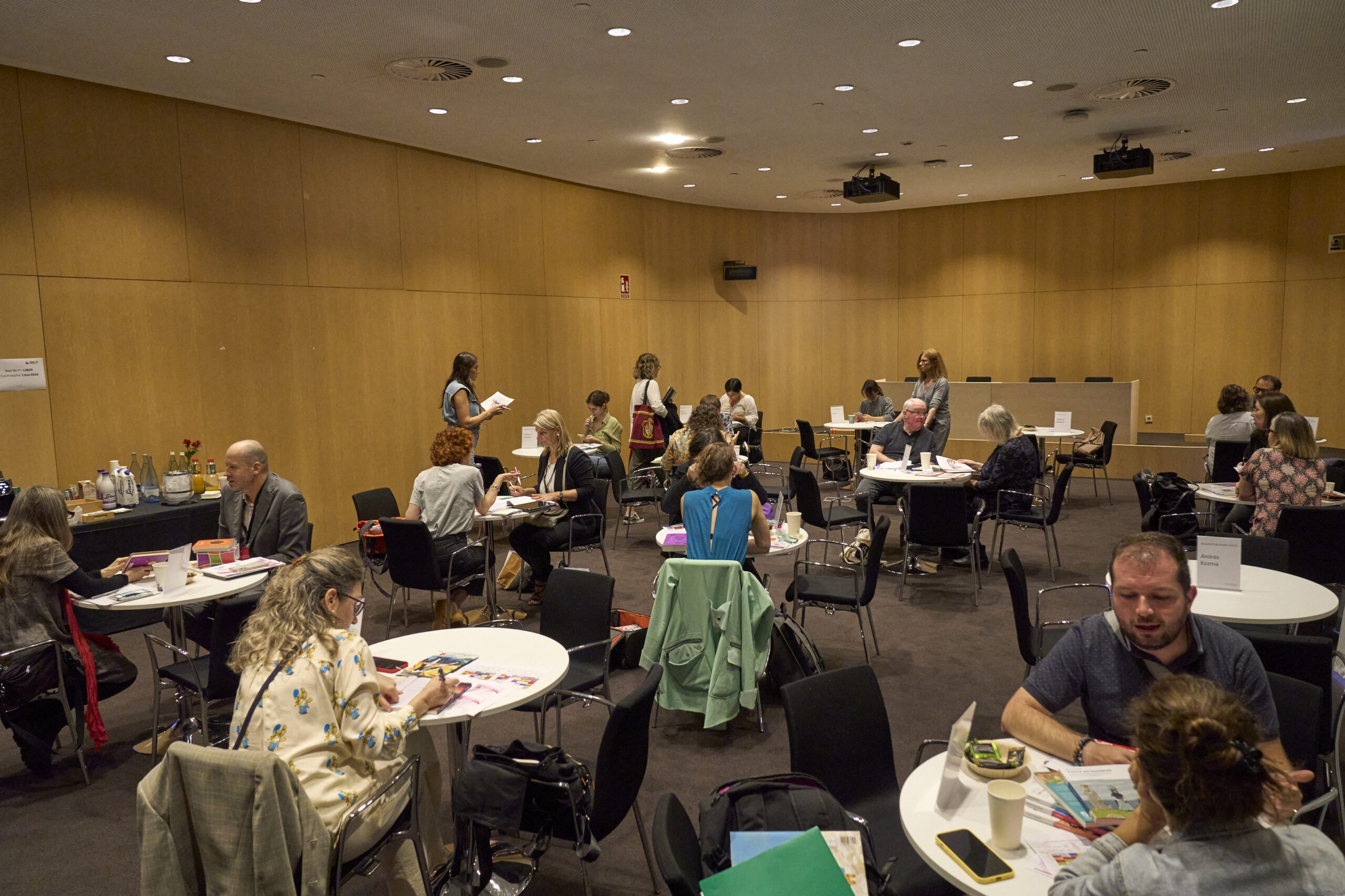
Publishers and agents to conclude translation, territorial rights, distribution and content adaptation agreements at the fair.
Rights Hall Gains Prominence at Liber as a Driver of International Growth
For the second consecutive year, Liber will bring together international rights negotiations in its Rights Hall, where publishers and literary agents will hold pre-scheduled business meetings. From 29 September to 1 October, this dedicated space will facilitate agreements covering translation rights, territorial licensing, co-editions and content adaptation across multiple formats, against a backdrop of growing exports of Spanish-language content. The initiative is supported by a dedicated international programme, through which invitations have been extended to 120 professionals from 46 countries.
For the second consecutive year, Liber will bring together international rights negotiations in its Rights Hall, where publishers and literary agents will hold pre-scheduled business meetings. From 29 September to 1 October, this dedicated space will facilitate agreements covering translation rights, territorial licensing, co-editions and content adaptation across multiple formats, against a backdrop of growing exports of Spanish-language content. The initiative is supported by a dedicated international programme, through which invitations have been extended to 120 professionals from 46 countries.
The evolution of the publishing industry confirms the growing importance of the rights business as a key driver of growth. According to the Spanish Publishers Association (FGEE), sales of Spanish books abroad reached €381 million in 2024, while rights sales exceeded €72.5 million, reinforcing their contribution to the international reach of works published in Spain’s languages.
This shift reflects the transition from a model focused on physical distribution to one centred on content circulation and intellectual property management. In this context, rights trading has become a strategic tool for expanding the international presence of authors and publishers while creating new revenue streams.
To address this reality, the Rights Hall, introduced at the previous edition of Liber, provides an environment specifically designed to facilitate these transactions, bringing together professional rights negotiations through structured schedules of one-to-one meetings.
“The Rights Hall is a key tool for supporting the internationalisation of the publishing industry and Spanish publishing, while connecting its leading players within an efficient business environment,” says Manuel González, President of both the Spanish Publishers Association (FGEE) and Liber. “Liber serves as a platform to promote the global circulation of Spanish-language content and create tangible growth opportunities.”
A Rights-Driven Publishing Model
The international expansion of Spanish publishing is increasingly supported by the export of intellectual property. Through rights sales, publishers enable titles from their catalogues to be published in other countries through agreements with local publishers, who assume responsibility for editing and distribution in exchange for financial compensation.
This system allows print runs, pricing and commercial strategies to be adapted to the characteristics of each market, while reducing logistics costs and business risks. For Spanish publishers, it provides recurring revenue opportunities while allowing them to retain ownership of their intellectual property and avoid direct involvement in local distribution.
Alongside these agreements, the management of subsidiary rights broadens the range of opportunities for content exploitation. Among the most significant are audiovisual adaptations, which enable books to be developed into films, television series or streaming productions, transforming publishing catalogues into intellectual property assets capable of generating value across multiple formats and markets.
At the same time, rights acquisition also plays a complementary role. Publishers acquire foreign titles for translation into Spanish, often securing extensive territorial rights. This then allows them to redistribute those works across different Spanish-speaking markets.
“Spain has established itself as a major rights management hub for the Spanish-speaking world, both through the sale and acquisition of content,” adds González. “This position strengthens the competitiveness of the Spanish publishing sector in the global marketplace.”
An Intensive International Business Agenda
The Rights Hall is supported by Liber’s various international programmes, which together are expected to attract more than 700 publishing professionals from 70 countries and generate over 4,000 business meetings during the fair. These programmes bring together publishers, literary agents, distributors, buyers and other key stakeholders involved in the internationalisation of the book industry, reflecting a strategy that combines the consolidation of traditional markets, particularly Latin America, with the expansion of Europe, North America and Asia as priority destinations.
A key initiative is the Literary Agents and International Publishers Programme, specifically designed to promote rights trading and featuring participants from a wide range of European, American and Asian markets.
Beyond the Rights Hall itself, business activity will also take place across the exhibition floor. This year, more than 250 publishing houses and companies will participate, showcasing their catalogues, new releases and services related to the marketing and distribution of books.
Liber 2026 is organised by Fira de Barcelona and promoted by the Spanish Publishers Association (FGEE). The event is sponsored by the Spanish Ministry of Culture, ICEX Spain Trade and Investment, CEDRO, the Government of Catalonia and Barcelona City Council, with the collaboration of Acción Cultural Española (AC/E), the Catalan Publishers Guild and the Catalan-language Publishers Association.
Barcelona, September 2026
Maria Dolors Herranz
Tel. 34 93 233 25 41
[email protected]