
The US Housing Crisis Task Force advisor, Bruce Katz, Leadership award
Tokyo chosen Smart City of 2026 at Smart City Expo World Congress
Tokyo has been selected as Smart City of 2026 this afternoon at the World Smart City Awards gala held at Smart City Expo World Congress (SCEWC). The awards acknowledge the most outstanding initiatives and projects in the innovation and urban transformation industry.
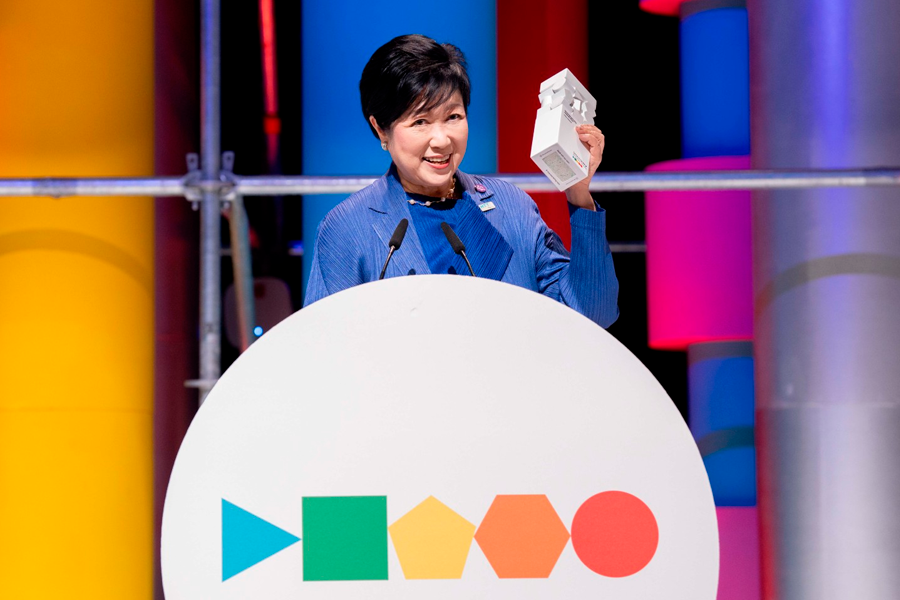
The Jury granted the City Award to the Japanese capital, through its Bureau of Digital Services, for “C³ Powering Tokyo”, a people-centred urban model built on the strength of citizens, communities and collaboration. Rather than letting technology lead, Tokyo puts residents at the center of its digital and AI transformation, so that a megacity of 14 million people can keep its scale without losing quality of life. The model is designed to be adapted by other cities around the world. The award was accepted by Yuriko Koike, Governor of the Tokyo Metropolitan Government.
This year’s special Leadership award went to Bruce Katz, Senior Advisor to the US National Housing Crisis Task Force and founder of New Localism Associates, in recognition of his contribution to fostering collaboration and shaping new urban policies. Katz is widely recognized for co-authoring the concept of “The New Localism”, a political and economic theory stating that power is shifting away from centralized national governments down to cities and metropolitan areas.
In the Innovation Award category, two winners were recognised. K-water (Daejeon, South Korea) was awarded for “Smart Village, Clean Energy”, a ZEB-certified community that integrates renewable energy systems and smart environmental technologies. LinQ Powr (Nairobi, Kenya) was awarded for “Second-Life Uptime Hubs”, which repurposes end-of-first-life EV batteries into modular solar-grid energy nodes that keep swap stations, SMEs and connectivity hubs online in weak-grid African cities.
AI as a common thread
Artificial intelligence runs through several of the winning projects. In the Living & Inclusion category, ICLEI Europe received the award for its “AI Opportunity Fund”, a free AI training programme for European city officials. The Mobility award went to the FIA for “Risk-Based Road Scores”, an AI-driven digital twin that predicts and reduces traffic safety risks. In the Energy & Environment category, URBIOLED (Romania) won for “Smart Light for the Ones Left Behind”, an AI-managed street lighting project built on 30,766 smart LED luminaires that change colour depending on the weather to improve visibility. In Enabling Technologies, Wapice (Finland) was recognised for its “Open City Innovation Engine”, an AI-powered platform that turns urban data into personalised services.
Housing takes centre stage
For the first time, the Awards included a Housing category, hosted together with the new HOWS Barcelona – Housing World Summit. The accolade went to the Bogotá District Secretariat of Habitat (Colombia) for “Mi Casa en Bogotá”, which combines affordable housing, neighbourhood renewal and mobility.
Housing was also the focus of the Infrastructure & Building category, where the award went to the Royal Commission for Riyadh City (Saudi Arabia) for the “Tawazun program”, offering affordable residential land to promote homeownership.
In Governance & Economy, the award went to Madrid City Council for “Madrid Intelligence in Action”, which integrates a digital twin, data and AI to improve air quality, energy and water management. The 2026 edition of the World Smart City Awards received 533 top-level proposals from 68 countries, reflecting the global momentum behind urban innovation.
Leading global urban innovation event
Smart City Expo World Congress, event on cities and smart urban solutions, is holding its fifteenth edition until November 5 at Fira de Barcelona’s Gran Via venue. Under the theme “Urban Solutions, Real Impact”, the event gathers over 1,100 exhibitors, representatives of over 1,000 cities and over 600 speakers.