
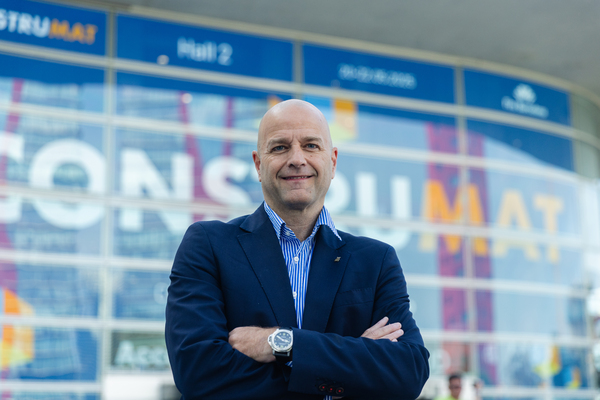
Interview with the President of the Construmat Organising Committee
Xavier Vilajoana: “Architecture is a driving force for change and innovation in construction”
This year, Barcelona is the World Capital of Architecture. As such, the city will host numerous events, conferences and activities to address the challenges of the 21st century. In this context, Construmat, the trade show organised by Fira de Barcelona, is joining the celebration with a programme of events as a prelude to its 25th edition in May 2027. The President of the Construmat Organising Committee and APCEspaña, Xavier Vilajoana, explains how the show is contributing to this global event and outlines some of the key content of the next edition of the sector’s most emblematic trade show.
Q: How do you assess Barcelona being the World Capital of Architecture in 2026?
A: Barcelona has always been an international benchmark in architecture and urban design, and in 2026 this position is further strengthened by this designation. This recognition not only highlights our architectural heritage but also projects the city as a hub for innovation and sustainability in this field. For Construmat, one of Fira de Barcelona’s flagship trade shows, it represents a unique opportunity to showcase how the industry, together with architecture, can lead the transformation towards more efficient, digital and environmentally friendly models.
How has Construmat’s connection to this distinction been made visible?
Construmat is playing a leading role in this very special year. We have designed a programme of activities that will serve as a prelude to our next edition in May 2027. These initiatives include hands-on demonstrations to highlight the importance of safety and professionalisation in the sector, as well as guided visits to buildings constructed with wood or eco-sustainable materials and to the facilities of various sponsors and exhibitors. We want to help ensure that Barcelona breathes architecture and construction throughout the year.
In this sense, what do you think is the role of architecture in the construction sector?
Architecture plays an essential role in the industry’s evolution, as it is the discipline that connects vision with execution. It not only defines what our spaces will look like but also incorporates criteria of sustainability, efficiency and well-being that are now indispensable. In this sense, it acts as a driver of change, fostering new ways of designing and building.
At Construmat, we promote this integration between architecture and industry, where innovation does not remain at the design stage but extends throughout the entire process. Today we talk about digitalisation, industrialisation and new materials, but also about quality of life and environmental impact. Architecture is key to aligning all these challenges and turning them into tangible solutions.
What is the message Construmat aims to convey?
We would like to continue emphasising the importance of our motto—Building Sustainability—as a shared objective for the entire sector. The construction industry is undergoing profound change, driven by the need to reduce environmental impact, adopt digital technologies and respond to the demand for affordable housing. Construmat aims to be the showcase for these solutions and the forum where the strategies shaping the future of the sector are defined.
What are the main challenges currently facing the construction sector in Spain, especially regarding the housing access crisis?
Today, the construction sector in Spain faces one of the most complex challenges of recent decades: a severe shortage of housing in the face of ever-growing demand. Forecasts suggest that by 2026 around 250,000 new homes will be needed, yet only between 90,000 and 110,000 are expected to be built, less than half of what is required. This structural gap is putting pressure on the market, driving up prices and making access more difficult, especially for young people and families.
Therefore, the sector’s main challenge—as well as that of all the public administrations involved—is to accelerate housing production, improve land availability, reduce costs arising from bureaucracy and reinforce the commitment to public and affordable housing. Only through a coordinated and sustained strategy will we be able to ensure decent access to housing and balanced growth in the sector.
On another note, could you point out the trends that will shape the sector’s future?
For several editions now, Construmat has been anticipating trends that the sector has gradually embraced. These are three key trends: industrialisation, to optimise processes and reduce costs; digitalisation, with technologies such as BIM and digital twins; and sustainability, involving recyclable materials, energy efficiency and circular economy principles. These trends are not optional—they are essential to meeting current and future challenges. Construmat will once again be the sector’s major cross-cutting platform, generating business opportunities, showcasing new solutions and connecting the main players in the construction ecosystem.
Finally, as President of Construmat and one year ahead of the event, how do you envision the 2027 edition?
It will be one of the most ambitious editions of recent years. We expect to bring together more than 400 exhibitors from over 20 countries, with the support of more than 160 industry associations and organisations, further consolidating the show—and Barcelona—as an international hub for construction. We are preparing an event that will once again feature its own congress, the Sustainable Building Congress, as well as spaces dedicated to technological innovation from the most disruptive startups and to sustainability, among other activities currently being designed. In addition, we will strengthen the international dimension with a programme for international buyers. All of this , aligned with the spirit of the World Capital of Architecture 2026.
Barcelona, 30 June 2026
Edu Pérez Moya
93 233 21 66
[email protected]