
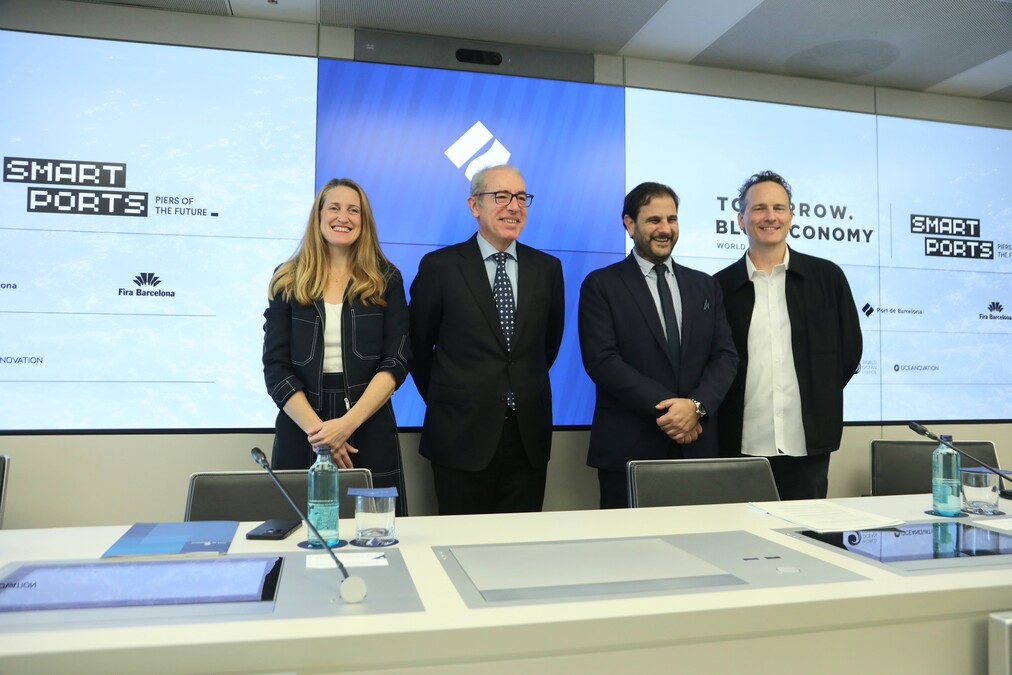
More than one hundred experts will highlight the importance of the marine ecosystem as a source of sustainable and regenerative development
Tomorrow.Blue Economy explores the potential of the blue economy for ports, cities and corporations
Fishing, aquaculture, port management, shipbuilding… These are some of the activities linked to the seas and ocean that make visible the importance of the marine ecosystem as a lever for socio-economic development. The enormous potential offered by the blue economy will be the focus of the fourth edition of Tomorrow.Blue Economy World Congress (TBEWC) which will take place from November 4-6 at Fira de Barcelona’s Gran Via venue as part of the Smart City Expo World Congress.
With 120 national and international experts and the aim of promoting the development of the blue economy, which seeks to transform marine resources into an economic powerhouse under a sustainable and regenerative approach, TBEWC will feature 42 sessions distributed among the three major events that comprise this year’s edition: Smart Ports: Piers of the Future, promoted by the Port of Barcelona; Global Blue Finance Summit and Sustainable Ocean Summit, both organized by the World Ocean Council (WOC).
The TBEWC will also have a start-up area, the Ocean Innovation Hub, where 30 emerging companies specialising in the field of the blue economy will showcase their projects, managed by WOC partner Oceanovation for the first time this year. Coming from countries such as China, Spain, the United States, the Netherlands, India and the United Kingdom, they will present solutions ranging from sensorized decontamination barriers, to materials that recover carbon from the bottom of the seas, technological applications that use AI or blockchain, floating wind platforms, underwater robots, black boxes for ships with IoT, proteins from the biomass of algae, coatings to prevent biofouling on ship hulls or hydrogen refuelling buoys for offshore vessels, and more.
Port Management & Finance
Representatives from 9 European, North American and Asian ports will participate in the seventh edition of the Smart Ports congress, including the President of the Port of Barcelona, José Alberto Carbonell; the Vice President of the Port of Busan (South Korea), Ja-rim KOO; or the CEO of the Port of Hamburg and president of the IAPH (International Association of Ports and Harbors, Jens Meier. Topics covered include cybersecurity, less polluting port operations, the integration of ports into the development of cities or the employment opportunities offered by the blue economy.
The Global Blue Finance Summit (BlueFIN) will focus on innovation, bluetech, marine and coastal systems as areas of public and private investment with representatives across the spectrum of venture capital, impact investing, banking and insurance and more, from local and global contexts. Speakers include Olivier Raybaud, Managing Director, SWEN Blue Capital; Dale Galvin, Managing Director, Global Fund for Coral Reefs Investment Fund; Esther Badiola, Principal Climate Adviser, European Investment Bank; Lucy Holmes, Senior Director Ocean Markets and Finance, WWF UK; Anton Gigov from Aquamarine Impact Capital Partners, to name a few.
During the Sustainable Ocean Summit (SOS), business, startup and innovator involvement in corporate ocean responsibility for a sustainable and regenerative blue economy will bring together topics as wide ranging as aquaculture, circularity, green shipping, blue jobs of the future, coastal resilience and much more, with speakers like Jason Giffen, Chief Sustainability & Innovation Officer, Port of San Diego; Kristijan Curavic-President, Ocean Alliance Conservation Member (OACM); Aisha Stenning, Business Action Lead: Plastics Team, Ellen McArthur Foundation; Ben Rubin, Executive Director and Founder, Carbon Business Council; Panagiotis Anastasopoulos, CEO, Patras Port Authority; Cristina Gil from the Global Reporting Initiative (GRI), among others.
The president of the Port of Barcelona, José Alberto Carbonell, stressed that “collaboration and innovation are key to facing the great challenges of the maritime and port sector. Barcelona has established itself as a hub for organisations committed to sustainability and digitalisation, and Smart Ports: Piers of the Future is the best example of our leadership and ability to generate global impact”.
The Barcelona City Council’s Commissioner for Economic Promotion, Trade and Catering, Nadia Quevedo, explained that “Barcelona remains firmly committed to the blue economy. Through Barcelona Activa, we have just finalized the first Government Measure on the Blue Economy, which has agreed and implemented, in partnership with all stakeholders in the sector, an action plan capable, for example, of providing 5,600 hours of training in reskilling programs or accelerating 32 entrepreneurial projects.”
For his part, the director of the TBEWC, Ugo Valenti, pointed out that “This edition strengthens the event’s position as the leading global trade show for promoting the blue economy by bringing together public institutions, leading companies, startups, and funding organizations for a three-day summit, which constitutes a strong example of public-private collaboration.”
WOC Chief Executive Officer (a.i.), Stewart Sarkozy-Banoczy, has stated that “WOC has been through some major changes over the last year and the topics, speakers, sessions and design of this year’s events reflect many of those changes. We are so pleased to again partner with the city and the port of Barcelona, and expand our deep collaboration with Oceanovation, showing unique value to members and attendees as we blend corporate, startup, innovation, investment and government voices on stage and off.”
Tomorrow.Blue Economy World Congress is organised by Fira de Barcelona with the collaboration of Barcelona City Council, through Barcelona Activa; the Port of Barcelona; the World Ocean Council (WOC); Oceanovation and Smart Ports: Piers of the Future, an initiative of the Port Authority of Barcelona.
Trade by sea
According to the United Nations, the blue economy brings 1.5 trillion dollars of added value to the world economy, generating more than 30 million jobs. Likewise, this organization highlights that more than 90% of international trade is carried out by sea, that the oceans absorb approximately 30% of CO₂ and 90% of the excess heat generated by climate change, as well as that 3,200 million people around the world depend directly on fish as the main source of animal protein.
For its part, the EU Blue Economy Report states that the blue economy generates more than 1.6% of the GDP of the twenty-seven countries of the European Union, employing more than 4.8 million people throughout Europe.
Tomorrow.Blue Economy World Congress, Tomorrow.Mobility World Congress and Tomorrow.Building World Congress are held together with Smart City Expo World Congress 2025, the world’s largest event on cities and urban innovation. The four events are expected to bring together more than 1,100 exhibitors, representing more than 850 cities and 140 countries.